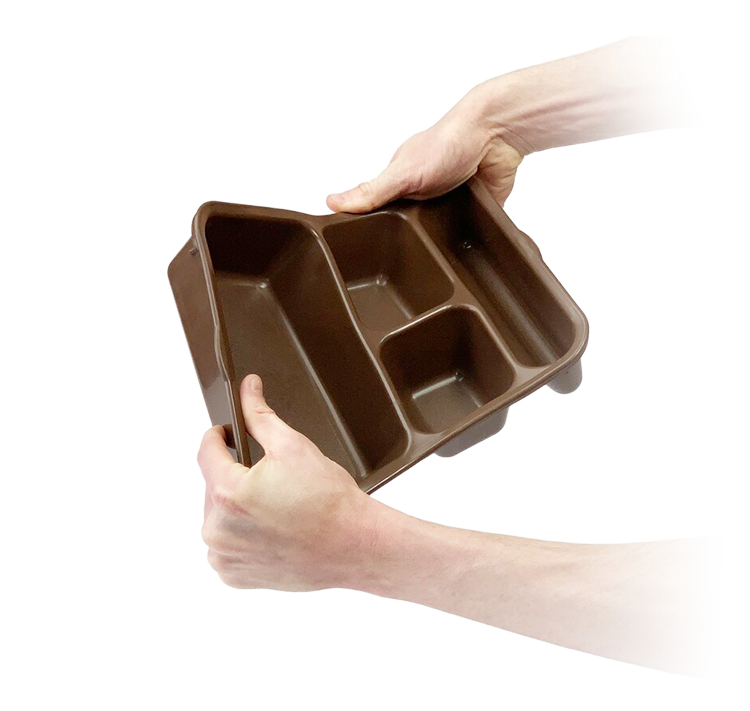
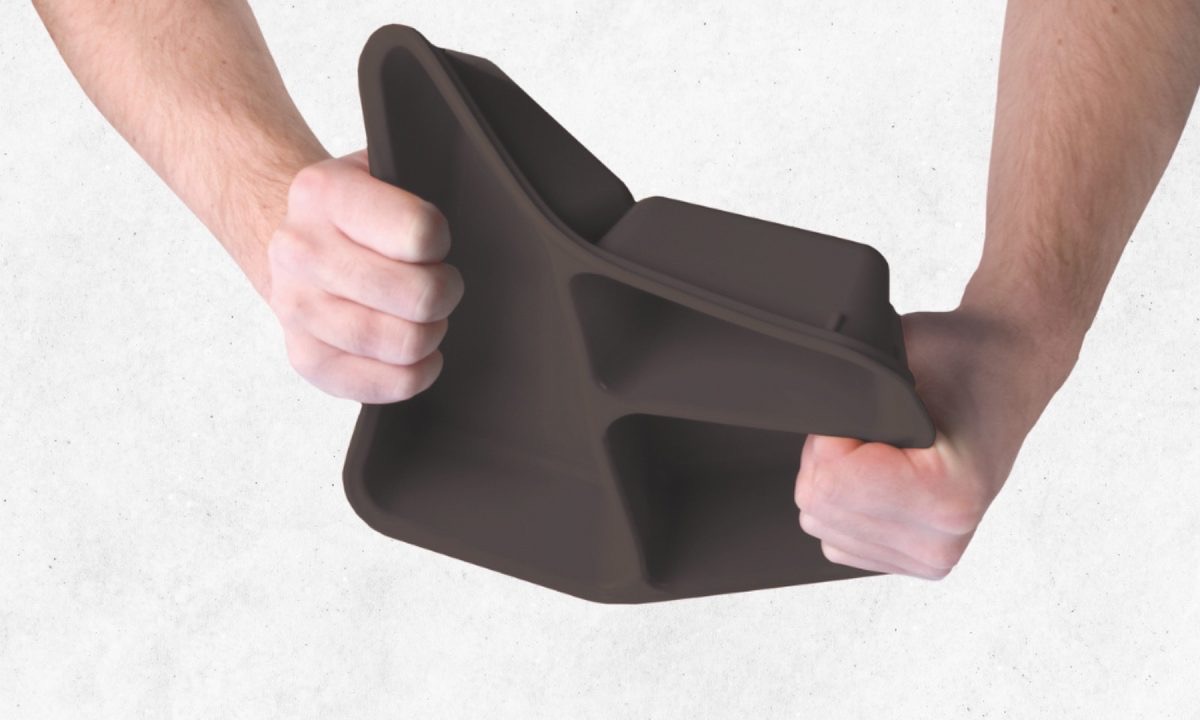
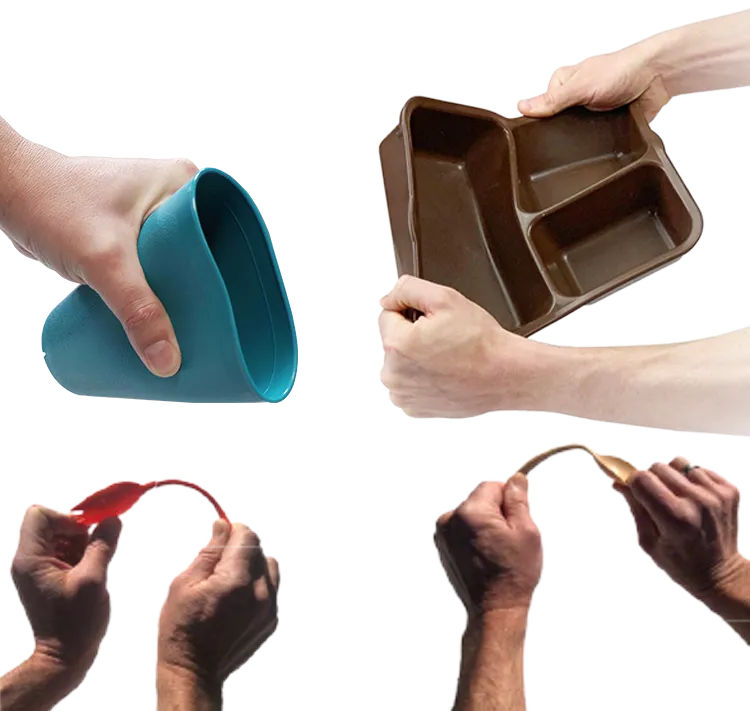
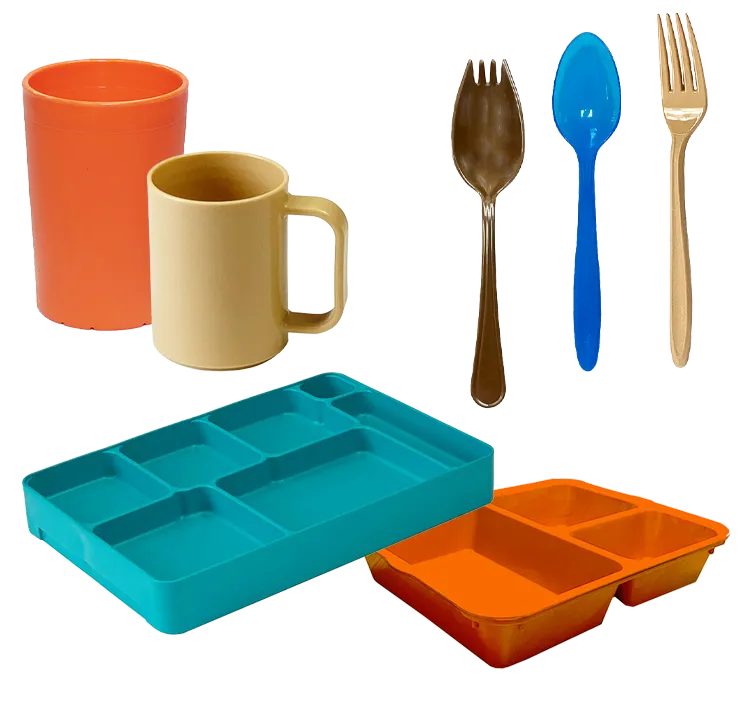
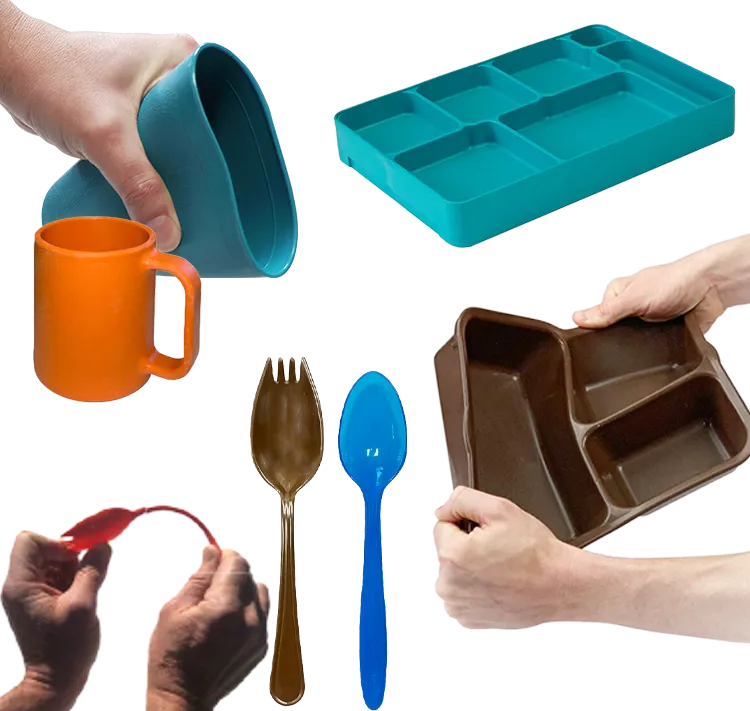
Correctional facilities can't afford dinnerware that becomes a security threat. MaxFlex is engineered from a proprietary polymer blend that flexes rather than breaks: it can't be sharpened, can't be fractured into shards, and tears with a dull edge if forced. If melted, it does not harden when cooled, eliminating another common weapon-making concern in secure environments.
Buy direct, or order through US Foods & Direct Supply on your existing distributor agreement.
Quick answer
MaxFlex is a proprietary polymer formulation used in specified JonesZylon products. JonesZylon rates MaxFlex at -40 to 225 degrees Fahrenheit, with flexural modulus < 50,000 psi and Shore D hardness > 40. Select each tray, lid or utensil by its own sheet, and review the model-specific safety wording with the staff who approve dinnerware for your facility.
Updated .
Shop MaxFlex by Category
Choose a product category below, then review the model sheet and plan a sample trial with your food service and security teams.
Review the exact model’s printed material language.
Use JonesZylon’s MaxFlex temperature rating, -40 to 225 °F.
Test the loaded meal arrangement and return procedure.
Request a Quote for MaxFlex Correctional Dinnerware
Tell us your facility type, volume needs, and preferred colors,
we'll get back to you with accurate pricing and make sure you're
getting the right products for your security environment.
Step 1 of 3
What type of facility are you with?
Select the option that best describes your facility.
Federal BOP
State DOC
Jail / Metro
Private Corrections
Corrections Distributor
Other
Step 2 of 3
How can we help?
Choose the option that fits what you're looking for.
Request a Quote
Request Dinnerware Samples
Contact Sales Team
Book a Free Consultation
Step 3 of 3
Tell us about yourself
·
Something went wrong. Please try again or email us at solutions@joneszylon.com.
Step 3 of 4
Which samples are you interested in?
Select one to continue. Each kit includes a tumbler, mug, utensil set, segmented tray, and SmartTray.
MaxFlex Flexible Safety Dinnerware
Flexes rather than breaks. Can't be sharpened or fractured into a weapon.
Copolymer Dinnerware
Durable, dishwasher-safe reusable dinnerware.
Send Me Both
Sample both lines side by side.
Special request? Use the message field on the next page to request specific items.
Step 4 of 4
Where should we ship your samples?
· samples
We'll ship your samples to the address below at no charge.
Something went wrong. Please try again or email us at solutions@joneszylon.com.
The linked MaxFlex sheets describe a “Proprietary polymer formulation.” Use that description with the selected product identifier. Check portion capacity on each item’s sheet, use JonesZylon’s MaxFlex rating of -40 to 225 °F for temperature, then test its handling with your menu.
Have staff check tray portions, lids and cart clearance. Test each dish with its food portion and place setting, and each cup with its serving fill and grip through delivery and return. Review utensils against the menu and controlled issue procedure. Record those requirements before choosing a sample assortment.
Which safety language belongs to each MaxFlex product?
For FXST-18, JonesZylon’s safety wording is “Maximum safety - cannot be fashioned into a weapon by melting and sharpening” and prints flexural modulus < 50,000 psi. FXSTB-14 carries the same wording, “Maximum safety - cannot be fashioned into a weapon,” with flexural modulus < 50,000 psi and Shore D hardness > 40.
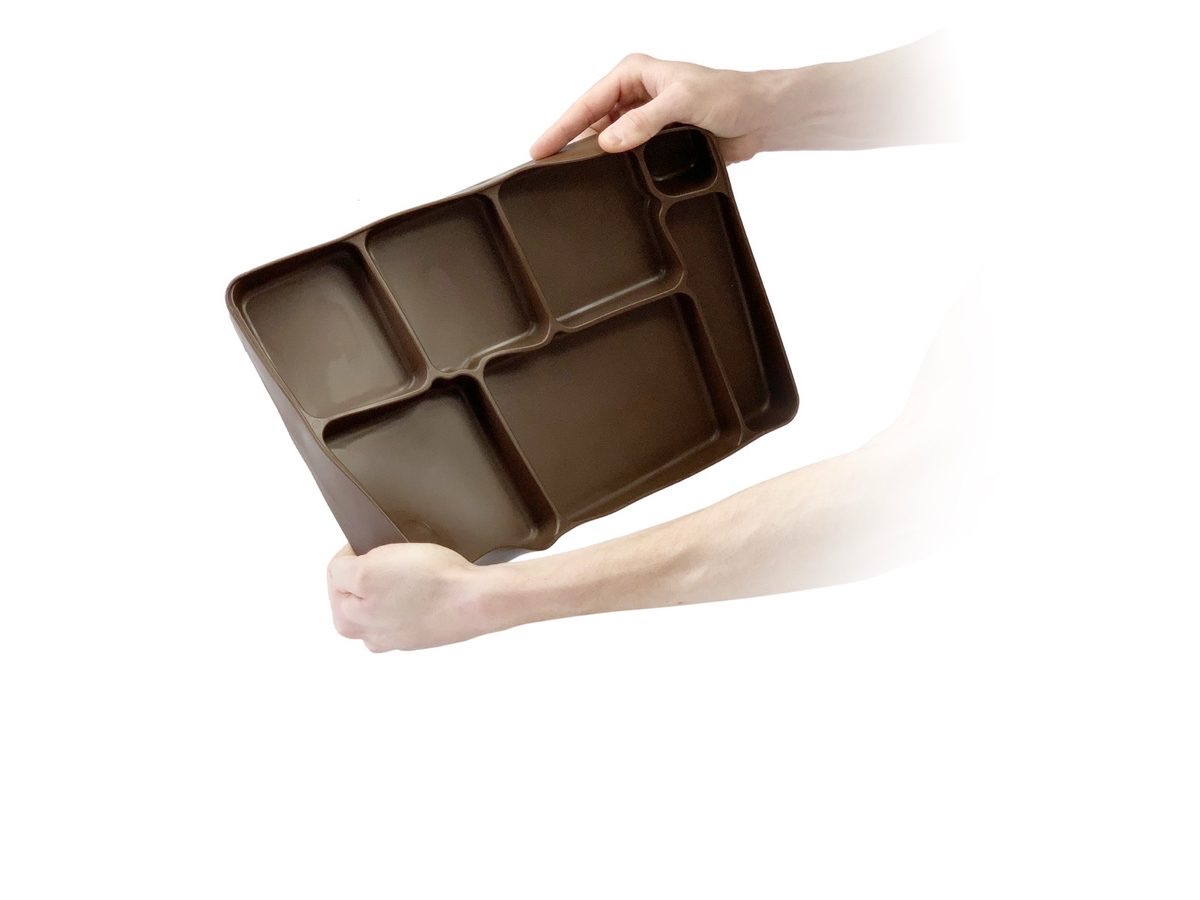
MaxFlex SmartTray (SMARTB-5) bent by hand. The SmartTray MaxFlex sheet carries JonesZylon’s safety wording, “Maximum Safety - cannot be fashioned into a weapon by melting and sharpening.”
Each statement applies to the named model. Attach the wording to that model in the evaluation record. Facility review should cover the selected product, its condition, the meal arrangement and the handling procedure. Linked family pages provide the individual sheets.
What temperature range applies to MaxFlex dinnerware?
JonesZylon rates MaxFlex dinnerware at -40 to 225 °F, with flexural modulus < 50,000 psi and Shore D hardness > 40. The temperature figure is a material rating, not a food-holding temperature.
JonesZylon dinnerware carries a 12-month warranty from the date of purchase against defects in material or workmanship. Dinnerware determined to be defective due to improper material or workmanship, at the sole discretion of JonesZylon, will be replaced at no charge. See the full warranty terms.
How should a facility compare flexible dinnerware samples?
Record the current item and the candidate item under the same menu and handling conditions. Use the same serving tools, food portions, route and wash process. Ask staff to record specific observations, including loaded bending, grip changes, spills, dish clearance and collection difficulty.
Keep purchase price, required inventory, observed losses and wash labor as separate entries in the review. Use the facility’s records for replacements. Base replacement rates, useful life and savings estimates on your facility records.
How to test a MaxFlex meal arrangement through a meal service
Load the tray, dish, cup and utensil assigned to one representative menu.
Check tray support, cup grip and dish movement during pickup, delivery and collection.
Count each item at issue and return, then inspect the complete set after the approved wash and drying process.
How many dinnerware pieces should a facility order?
Count trays, lids, dishes, cups and utensils at the point when meal services overlap. Include pieces in use, awaiting return, washing and drying. Use the facility trial to set reserve stock. Record when each item becomes available for the next dispatch.
Keep a separate inventory line for each model. Record required pieces first, then convert to cases using the matching sheet and current quote.
Frequently asked questions
What is MaxFlex made of?
The linked JonesZylon specifications describe a “Proprietary polymer formulation.”
Does every MaxFlex item share one temperature range?
Yes. JonesZylon rates MaxFlex products at -40 to 225 °F.
Which product categories can be evaluated?
Review trays, plates and bowls, drinkware and utensils through the linked family pages, then request the specific models needed for the trial.
Can a tray’s material language be applied to every utensil?
Keep each claim attached to the product documented in the matching specification sheet.
How should replacement inventory be planned?
Use recorded issue, return, damage and wash-turnaround counts from your facility, then confirm purchasing units in the quote.
JonesZylon model specification sheets, reviewed from local copies September 8, 2026. Model details come from the linked sheets. The MaxFlex temperature, flexural modulus and Shore D ratings are JonesZylon’s, confirmed September 25, 2026.