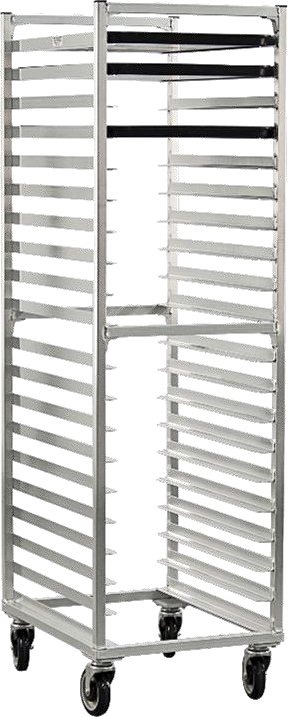
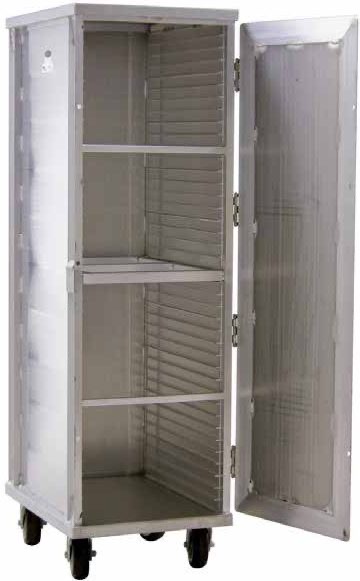
Engineered for corrections environments, JonesZylon's heavy-duty aluminum pan racks make transporting trays of food fast and easy. Choose from open or enclosed configurations, both built with high-tensile, all-welded aluminum.
The open model ends in the letter O. The enclosed sheet lists a door that opens 270°, a gravity catch and padlock holes. JZA-1826-38-E specification (PDF)
Which correctional bun pan rack fits your pans and loaded food height?
Select a correctional bun pan rack by pan size, loaded food height, access and route. The open JZA-1826-20-O lists 20 sheet pans; the enclosed JZA-1826-38-E lists 38. Runner spacing still needs a loaded-pan check.
Bun Pan Rack Pricing
Find the Right Bun Pan Rack
Tell us whether you need an open or enclosed rack, your pan capacity,
and any security or mobility requirements. We’ll recommend the right
configuration and provide facility pricing.
Open or enclosed. Choose easy-access storage or secure enclosed transport.
Capacity. Share your 18 × 26 pan count and preferred runner spacing.
Facility needs. Note caster, locking, clearance, or accessory requirements.
Not sure which model fits?
Tell us how the rack will be used and the number of pans you need to handle.
Step 1 of 2
What type of facility are you purchasing for?
Your facility type helps us route the request and recommend the
right rack configuration.
Step 2 of 2
Tell us about your bun pan rack needs
Share your contact information and the capacity, rack style, and
facility requirements you need us to consider.
Include open or enclosed, approximate pan quantity, runner spacing,
clearance, casters, locks, and accessories when known.
Something went wrong. Please try again or email
solutions@joneszylon.com.
Your request has been received.
A JonesZylon representative will review your bun pan rack needs
and follow up with pricing and recommended options.
Match pan height to runner spacing
List the pans used for each menu step, including covered pans and batches that need more vertical space. Measure the loaded pan and cover together. Take the measurements at the highest point and include the clearance staff need to insert and remove a pan without touching the food above it.
Compare those measurements with the runner spacing in the table. If your process leaves runner positions empty, use the resulting usable pan count in the purchasing calculation. Identify separate loading plans for empty sheet pans and pans carrying prepared food in the quote request.
Should your pan rack be open or enclosed?
The open configuration gives direct runner access. The enclosed JZA-1826-38-E adds a door, gravity catch and padlock holes. Check the loaded rack and open door against the route and parking space.
How many rack movements does your menu require?
Divide the peak pan count by the usable runner positions for the actual pan depth, food height and cover. Round up, then include the loaded trip and empty return in the kitchen schedule.
What should staff check before moving a loaded rack?
Use the facility handling procedure to inspect runners, casters, frame and door hardware. Record any loose components, damaged runners or interference with the pan edge. Have authorized staff resolve defects before returning the rack to service. Check the loaded route, especially transitions between flooring materials and the turning space near doors.
The open-rack sheet lists swivel casters, while the enclosed-rack sheet describes the door catch and padlock holes. Ask JonesZylon to confirm any accessory for the selected rack.
How do pan washing, drying and rack storage connect?
Plan dirty return, washing, drying and clean storage around the same pan count. If drying limits the cycle, compare the pan drying rack and insert configurations with the bun pan rack load.
Frequently asked questions
What is the correct open bun pan rack model?
JZA-1826-20-O is the model printed on the sheet; the final character is the letter O.
How many sheet pans fit?
Published capacities are 20 pans for the open rack and 38 for the enclosed rack, based on 18 × 26-inch sheet pans. Check loaded clearance before using every runner.
Can an enclosed rack replace a heated cabinet?
No heating specification appears on the enclosed-rack sheet. Select holding equipment separately when heat is required.