County jail food service equipment
Build a purchase request around the meal count, housing route and people who approve the equipment.
TL;DR
- For a county jail, size equipment around the largest meal dispatch, the share served in cells and the time available to wash and return trays. Give the sheriff or jail administrator a route trial and give county purchasing a model-specific specification.
Who buys food service equipment for a county jail?
The sheriff or jail administrator sets the operating and security requirements. The food service supervisor should document the trayline, meal counts and return process. County purchasing should identify the approval route before preparing a replacement order. Local assignments vary; the purchase request needs a named operations reviewer, security reviewer and purchasing contact. Agency examples in the source record assign food service oversight, cart handling and equipment accountability to specific staff positions.[1]
Send those reviewers the same packet. Include the current tray and lid codes, requested quantities, cart configuration, power needs, delivery address and the reason for replacement. Ask purchasing whether the order requires quotes, a bid or an available contract route. Record its answer in the file. Have purchasing confirm authority to use any proposed cooperative contract.
How do changing jail counts affect tray and cart quantities?
Build the meal count by housing unit and dispatch time. Include intake meals, people returning from court, medical diets and meals served in segregation. Use the largest expected dispatch to test loading. Count meals leaving the kitchen together and dinnerware awaiting washing separately from licensed beds.
Which trays and carts should the jail evaluate?
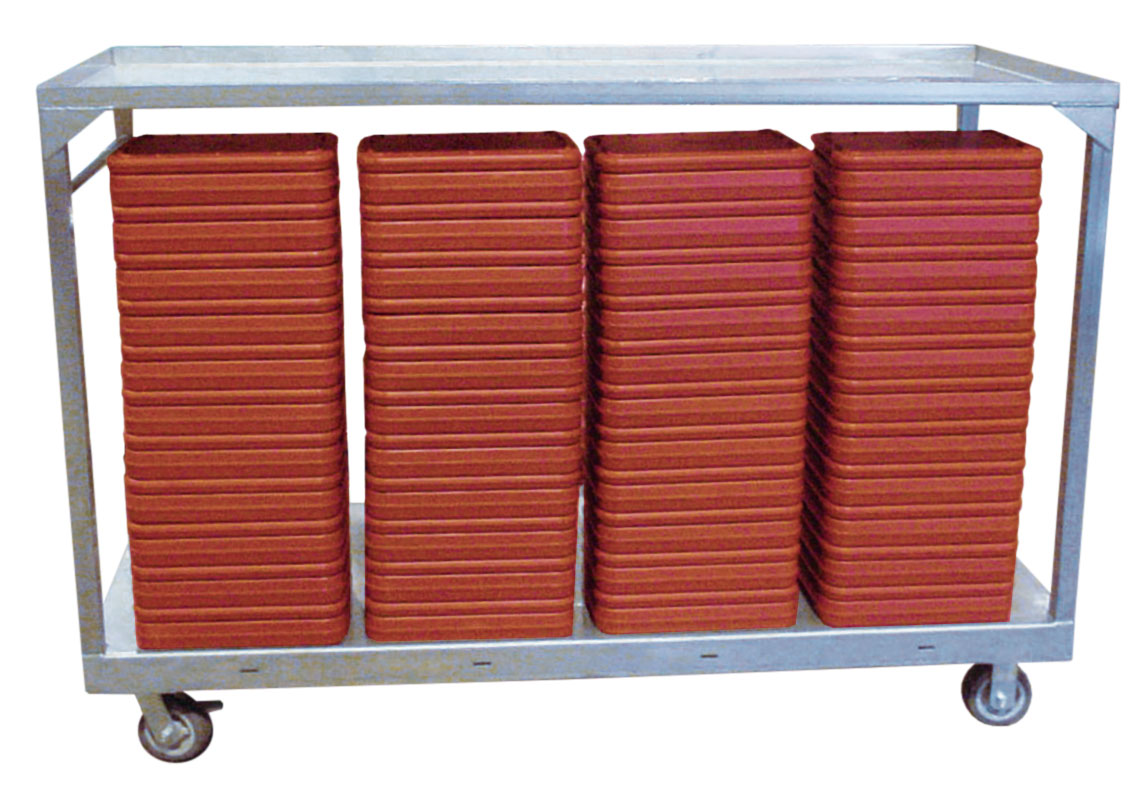
Use segregation tray specifications when the food-port opening controls tray selection. The table lists the ServeSmart carts from the ServeSmart Buying Guide[5] and the TC transport carts from the transport cart page, with each sheet's printed size and tray capacity. Test the exact tray, lid and loaded meal on the route before setting a cart load.
| Cart | Printed size (H × W × D) and tray capacity | Specification source |
|---|---|---|
| ServeSmart carts | ||
| JZH-54-RH heated cabinet | Narrow cart for small housing units. 47.80 × 21.50 × 38.25 inches (H × W × D). 54 SmartTrays or 39 SmartTray XD trays. | JZH-54-RH.pdf Buying Guide |
| JZH-6UBT-RH heated cabinet | Small cart for small to medium housing units. 47.30 × 30.75 × 38.25 inches. 90 SmartTrays or 65 SmartTray XD trays. | JZH-6UBT-RH.pdf Buying Guide |
| JZH-136-RH heated cart | Medium cart for mid-sized housing units. 47.50 × 54.88 × 31.00 inches. 136 SmartTrays or 96 SmartTray XD trays. | JZH-136-RH.pdf Buying Guide |
| JZH-168 heated cart | Large cart for larger housing units. 47.50 × 62.90 × 31.00 inches. 162 SmartTrays or 130 SmartTray XD trays. | JZH-168.pdf Buying Guide |
| JZH-168XL heated cart | Large cart for larger housing units. 47.50 × 62.90 × 32.50 inches. 170 SmartTrays or 130 SmartTray XD trays. | JZH-168XL.pdf Buying Guide |
| JZH-192XL heated cart | Large cart for larger housing units. 51.00 × 62.90 × 32.50 inches. 190 SmartTrays or 150 SmartTray XD trays. | JZH-192XL.pdf Buying Guide |
| TC transport carts (aluminum) | ||
| TC-49A open cart | 47.00 × 28.00 × 40.00 inches. PRTS-4000/4001: 84; PRTS-5000: 119, or 77 with lids; PRTS-6000: 90, or 54 with lids. | TC-49A.pdf |
| TC-69A open cart | 47.00 × 28.00 × 69.00 inches. PRTS-4000/4001: 112; PRTS-5000: 153; PRTS-6000: 120. | TC-69A.pdf |
| TC-60 enclosed cart | 38.10 × 27.75 × 33.10 inches. SmartTray 60; PRTS-5000 36; PRTS-4000 18. | TC-60.pdf |
| TC-90 enclosed cart | 43.10 × 44.75 × 24.40 inches. SmartTray 90; PRTS-5000 39; PRTS-4000 30. | TC-90.pdf |
| TC-136 enclosed cart | 46.90 × 50.90 × 28.50 inches. SmartTray 136; PRTS-5000 90; PRTS-4000 36. | TC-136.pdf |
| TC-170 enclosed cart | 47.10 × 60.20 × 28.50 inches. SmartTray 170; PRTS-5000 105; PRTS-4000 48. | TC-170.pdf |
| TC-73E enclosed cart | 54.10 × 73.50 × 34.00 inches. PRTS-4000 140; PRTS-5000 216; PRTS-6000 135. | TC-73E.pdf |
| TC-180 enclosed cart | 47.10 × 60.38 × 30.75 inches. Clamshell transport. Clamshell transport: the sheet lists 180 9 x 9.38 inch Styrofoam clamshells. Ask JonesZylon for the loading drawing. | TC-180.pdf |
A jail keeping its present insulated tray process can review insulated trays and tray transport carts against that existing load. A proposed change to ServeSmart needs a complete trial through loading, delivery, return and washing. Keep the purchase scope tied to the process being evaluated.
What does a county jail meal delivery trial include?
Planning example, assumed counts. A dispatch has 120 meals, with 96 served through the chow hall and 24 delivered to cells. The cell-delivery share is 24 ÷ 120 = 20%. Use facility trial results to replace these assumed counts; they describe no customer installation or product capacity.
- Freeze the dispatch list with custody staff. Mark the destination and approved diet for each cell meal. Assign responsibility for any count change after the list closes.
- Plate the chow hall and cell meals to their separate schedules. Check the cell meal in the actual tray and lid, including tall food items and utensils.
- Load the cell route in service order. If the tested load is 12 complete meals per trip, 24 meals need 2 loaded outbound trips. This assumed load must be replaced by the trial result.
- Record departure, arrival and food temperature using the facility procedure. Include the wait for an officer to open access. Record late meals separately, including any second delivery route.
- Count returned trays, lids and utensils against issued quantities. Send soiled ware to the wash area and record missing or damaged pieces before clean stock is released.
How much dinnerware is needed during washing?
Track ware in service, awaiting wash, being washed, drying and available for the next dispatch. If the example's 120 issued trays remain unavailable when another 120 are needed, the process needs 240 usable trays before the facility adds its chosen reserve. Set the replacement rate and reserve from facility records separately from this cycle calculation.
Use the facility's approved scrape, wash, rinse, sanitize and air-dry sequence. Check the documented care limits for each product and the wash equipment instructions. CDC guidance calls for spare trays and utensils and attention to damaged ware. Include drying space and clean storage in the trial. Measure when trays are dry and ready for the next load.[2] Review tray drying racks against the actual tray dimensions.
Which jail food service standards belong in the bid?
Identify the jail's state rule, local food authority and applicable accreditation edition. Ohio's full-service jail food service rule is OAC 5120:1-8-10 in the edition reviewed for this page.[3] The DC DOC policy provides a documented example of adult local detention food service references and contractor oversight. Its requirements should be read in their own agency context.[1]
Attach the relevant facility requirements to the specification. Ask bidders to identify the exact models offered and exceptions requiring review. Keep the route record, sample acceptance, care instructions and delivery inspection with the purchasing file. Request Free Samples for the tray trial, then Request a Quote with the accepted configuration and quantities.
Standards and purchasing guides
Frequently asked questions
Should the sheriff or kitchen supervisor select the tray?
The kitchen supervisor should test the menu and washing process. The sheriff or jail administrator should identify the security reviewer. County purchasing should confirm who can approve and place the order.
Can one cart handle chow hall and segregation service?
Evaluate each load, dispatch time and route. A cart shared between routes must return, be cleaned as required and be available before the next load leaves. Confirm each tray and lid configuration with the equipment specification.
How do we size a food-port tray?
Measure the clear opening, hardware and receiving surface. Test the intended tray and lid with the actual menu under staff supervision. A printed tray dimension is one input to the fit review.
What should a county jail send with its quote request?
Send current model codes, meal counts by route, diet needs, tray and lid quantities, door measurements, available power, washing constraints and the purchasing contact. Include the trial findings and any required bid documentation.
Plan the equipment review with JonesZylon
Send your menu, route measurements, current model codes and purchasing requirements.
800-848-8160 | solutions@joneszylon.com | 305 Center Street, West Lafayette, OH 43845
Sources
- DC DOC Food Service Program policy 2120.3F, November 2022. https://doc.dc.gov/sites/default/files/dc/sites/doc/publication/attachments/PP%202120.3F%20Food%20Service%20Program%2011-03-2022.pdf (accessed 2026-09-05)
- CDC model food safety practices for correctional facilities, 2024 guidance. https://www.cdc.gov/correctional-health/media/pdfs/2025/02/Model-Food-Safety-Practices-for-Correctional-Facilities_508.pdf (accessed 2026-09-05)
- Ohio full-service jail food service rule, OAC 5120:1-8-10, edition reviewed September 5, 2026. https://codes.ohio.gov/ohio-administrative-code/rule-5120:1-8-10 (accessed 2026-09-05)
- JZH-54-RH specification sheet. /pdf/Equipment/Heated%20Carts/JZH-54-RH.pdf (accessed 2026-09-08)
- ServeSmart Buying Guide, cart fleet page. /pdf/servesmart/ServeSmart%20Buying%20Guide.pdf (accessed 2026-10-26)