Food service equipment for state corrections
Write a shared specification that accounts for the routes, menus and wash systems at each institution.
TL;DR
- State DOC equipment selection starts with a shared specification and institution-level exceptions. Evaluate chow hall service, satellite routes and segregation separately, then document the exact tray, cart and cleaning configuration approved for each use.
Who specifies equipment for a state corrections system?
State DOC food service equipment decisions should bring the central food service administrator, institution food service staff, custody, maintenance and state purchasing into the specification review. Central staff can define the menu and documentation needs. Institution staff should supply the route and wash-system measurements. Purchasing should define the solicitation format, required evidence and method for evaluating offered equivalents.
How do chow hall and satellite feeding change the specification?
Build a site matrix with population served per meal, chow hall seats, serving periods, satellite destinations and the segregation share. Record how much of the menu is plated in the central kitchen and how much is portioned at the serving location. Give purchasing the simultaneous dispatch load for each kitchen alongside the statewide population total.
Separate a bulk-food route from a preportioned-tray route in that matrix. Bulk service needs the actual pan size, depth, portioning tools and serving location. Preportioned service needs the tray, lid, rack spacing and load sequence. Include elevator access, outdoor travel, door clearances and available power. Record exceptions at the institution level so they remain visible when replacement orders are placed.
Which JonesZylon products fit the state DOC review?
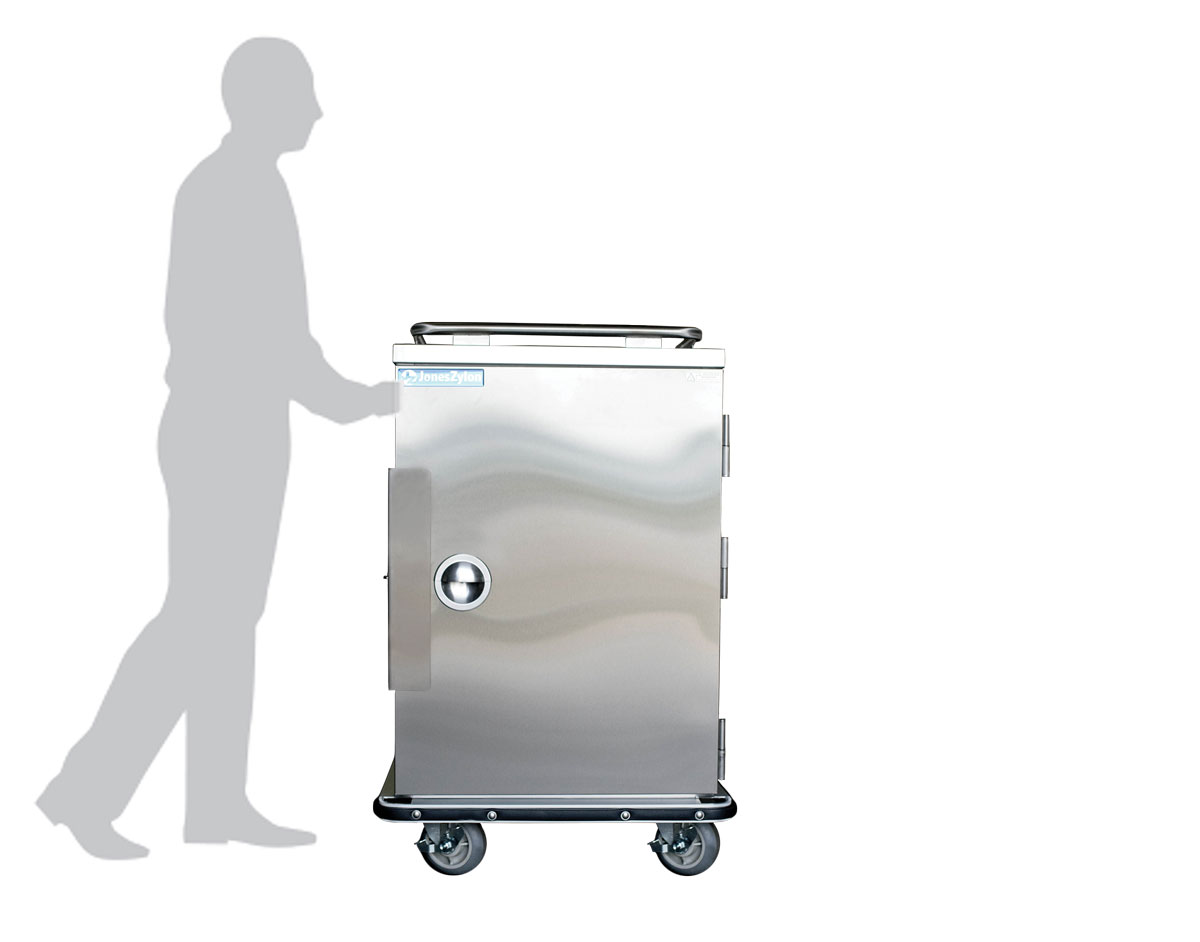
Start with SmartTray specifications for a stacked tray workflow, compartment trays for menu layout selection and bulk-food cart documentation for pan-based delivery. The ServeSmart carts in the table come in six SmartTray capacities, from 54 to 190, as listed in the ServeSmart Buying Guide.[6]
| Product | Printed specification and evaluation question | Specification source |
|---|---|---|
| SMART-5 SmartTray | 13.4 × 9.25 × 1.9 inches. The sheet describes stacking without lids in a straight stable column. Test the tallest menu items and the return stack. | SmartTray-Copolymer.pdf |
| SMARTB-5 MaxFlex SmartTray | 13.4 × 9.25 × 1.9 inches. Evaluate the documented MaxFlex version with the institution security and food service reviewers. | SmartTray-MaxFlex.pdf |
| JZH-54-RH heated cabinet | The printed capacity is 54 JZ SmartTrays or 39 JZ SmartTray XD trays. Specify which tray the ordered configuration will carry. | JZH-54-RH.pdf Buying Guide |
| JZH-6UBT-RH heated cabinet | Small cart for small to medium housing units. The printed capacity is 90 JZ SmartTrays or 65 JZ SmartTray XD trays. | JZH-6UBT-RH.pdf Buying Guide |
| JZH-136-RH heated cart | Medium cart for mid-sized housing units. The printed capacity is 136 JZ SmartTrays or 96 JZ SmartTray XD trays. | JZH-136-RH.pdf Buying Guide |
| JZH-168 heated cart | Large cart for larger housing units. The printed capacity is 162 JZ SmartTrays or 130 JZ SmartTray XD trays. | JZH-168.pdf Buying Guide |
| JZH-168XL heated cart | Large cart for larger housing units. The printed capacity is 170 JZ SmartTrays or 130 JZ SmartTray XD trays. | JZH-168XL.pdf Buying Guide |
| JZH-192XL heated cart | Large cart for larger housing units. The printed capacity is 190 JZ SmartTrays or 150 JZ SmartTray XD trays. | JZH-192XL.pdf Buying Guide |
The SMARTB-5 specification records the material and dimensions for that documented tray.[4] Security staff should assess the product in the institution's handling process. Have the DOC document its approval for the intended institution and use.
How should a state DOC compare offered equivalents?
Write acceptance criteria around observable requirements. Identify compartment layout, meal clearance, lid identification, loaded cart dimensions, power, handling hardware and care instructions. Request the applicable specification sheet for every offered model. Have the reviewer record whether each criterion is met, needs a sample test or requires a written exception.
Keep capacity tied to the actual configuration. A larger tray may change how many fit in the same cabinet. A meal using separate hot and cold trays also changes the relation between trays and meals. Require bidders to describe both components and where each is carried. Use cart and tray compatibility guidance to document the load basis.
What does an institution trial look like?
Planning example, assumed counts. An institution serves 600 meals at one meal period. Of these, 450 use the chow hall and 150 use satellite service. The satellite share is 150 ÷ 600 = 25%. Within that satellite group, assume 30 segregation meals; the segregation share of the whole meal count is 5%. Replace these assumed planning inputs with institution counts.
- Approve the menu, destination counts and special-diet list with institution staff. Assign different records to chow hall, ordinary satellite and segregation service.
- Test loading with the proposed tray and cart configuration. If the ordinary satellite route carries 120 meals in tested loads of 40, plan 3 loaded departures for that route. Size the separate segregation route from its own loaded trial.
- Run the longest route at the expected dispatch time. Include doors, elevator waits, custody handoffs and the serving queue. Record food temperature under the institution's approved procedure.
- Return and reconcile trays, lids and utensils by destination. Time the wash and drying cycle before declaring the same inventory available for another meal period.
- Submit the trial record and all exceptions to central food service and purchasing. An accepted configuration becomes a dated ordering record for that institution.
How do cleaning and replacement records support standardization?
Give each institution a record of usable stock, damaged items, missing pieces and ware awaiting cleaning. Distinguish routine replacement from an expansion in meal count. Keep tray and lid codes together on replacement requests, and test any proposed change.
Follow the approved washing and sanitizing procedure, then air-dry and inspect ware before storage. Check the exact product care limits and equipment instructions. CDC's correctional guidance addresses temperature logs, spare dinnerware and damaged trays.[2] Include drying rack selection in the site review, along with room for separate clean and soiled handling.
Which ACA food service references apply to prisons?
The ACA Adult Correctional Institutions fifth-edition Food Service section is 5C. Its expected practices address meal records, purchasing, diet review, equipment documentation and inspections.[1] Identify the edition and practices used by the DOC and each institution before translating them into bid requirements. Agency policy and the applicable food authority also belong in that review.
Request model-specific documentation and the institution's acceptance criteria with the quote. An equipment selection supports the facility's process; the facility remains responsible for its accreditation and operating records. Schedule a Virtual Demo with central and institution staff, and Request Free Samples for the menu and wash trial.
Standards and purchasing guides
Frequently asked questions
Can every institution use the same tray?
A shared tray specification needs menu, security, cart, washing and route checks at the institutions involved. Record an exception where a site cannot use the selected configuration.
Should tray capacity equal meal capacity in the bid?
State both quantities and explain the load. If a meal uses separate hot and cold trays, include both in the capacity review. Identify the actual tray, lid and rack configuration.
How should a DOC evaluate an equivalent product?
Request a specification for the offered model and a response to each acceptance criterion. Test unresolved fit and handling questions with samples. Keep the review and any approved exceptions with the purchasing file.
What should be included in a statewide replacement record?
Record the institution, current model, approved replacement, lid code, accepted cart load, care instructions, receiving requirements and approval date. Keep site-specific exceptions attached to the order record.
Plan the equipment review with JonesZylon
Send your menu, route measurements, current model codes and purchasing requirements.
800-848-8160 | solutions@joneszylon.com | 305 Center Street, West Lafayette, OH 43845
Sources
- ACA Adult Correctional Institutions, fifth edition, Food Service 5C. https://hcsoc.hawaii.gov/wp-content/uploads/2024/02/Perf-Based-Stds_Adult-Corr.-Inst.-5th-ed_March-2021_SECURE.pdf (accessed 2026-09-05)
- CDC model food safety practices for correctional facilities, 2024 guidance. https://www.cdc.gov/correctional-health/media/pdfs/2025/02/Model-Food-Safety-Practices-for-Correctional-Facilities_508.pdf (accessed 2026-09-05)
- SmartTray-Copolymer specification sheet. /pdf/Dinnerware/Compartment%20Trays/SmartTray-Copolymer.pdf (accessed 2026-09-08)
- SmartTray-MaxFlex specification sheet. /pdf/Dinnerware/Compartment%20Trays/SmartTray-MaxFlex.pdf (accessed 2026-09-08)
- JZH-54-RH specification sheet. /pdf/Equipment/Heated%20Carts/JZH-54-RH.pdf (accessed 2026-09-08)
- ServeSmart Buying Guide, cart fleet page. /pdf/servesmart/ServeSmart%20Buying%20Guide.pdf (accessed 2026-10-26)