ACA food service standards for equipment planning
A working guide for food service directors, custody staff and purchasing teams. Source review dated September 8, 2026.
TL;DR
- Identify the applicable ACA manual and supplements with the accreditation coordinator. [1]
- Collect tray, cart, sanitation and custody evidence using the proposed worksheet below.
- For exact food service standard numbers and temperature limits, verify against the current edition.
Which ACA food service standards apply to a prison or jail?
ACA publishes manuals for different facility and program types. Its FAQ directs facilities to work with ACA staff to select the applicable manual and to check committee minutes and supplements for changes. Ask the accreditation coordinator to record the manual, edition and supplements before writing equipment specifications. [1]
For prison or jail food service provisions, verify against the current edition selected for the facility. The licensed food service text was unavailable for this review. Obtain exact standard numbers, mandatory classifications, inspection intervals and temperature requirements from the coordinator before using them as acceptance criteria. The worksheet below proposes evidence to collect for trays, dinnerware and delivery equipment.
What equipment evidence should the accreditation file contain?
Build an equipment record around the facility's adopted wording. Give every selected provision a row with its exact text, the local procedure, the equipment involved and the observation that demonstrates the procedure. Have the coordinator enter the standard identifier after checking the licensed manual. Ask the coordinator to identify the food service and sanitation provisions applicable to this facility. [1]
| Review topic | Equipment decision to examine | Evidence to assemble |
|---|---|---|
| Meal temperatures | Identify the food measurement point, dispatch delay and last meal served. Review the proposed cart and tray together. | Attach the applicable provision, food-temperature log and route record. |
| Tray and dinnerware condition | Inspect tray wells, rims, lids and utensil edges with the kitchen and custody reviewers. | Record the model, observed damage, removal decision and replacement process. |
| Sanitation and storage | Trace each item through collection, washing, rinsing, sanitizing, drying and protected storage. | Attach approved care instructions, wash-process records and rack layout. |
| Cutlery handling | Document issue, retrieval, counting, storage and response to a missing item under local policy. | Identify the custody reviewer and retain a completed count sheet. |
| Special diets and portions | Check menu identification, serving tools, tray space and delivery handoff. | Attach the approved diet workflow and a sample meal assembly record. |
How do trays and carts affect the meal delivery review?
Start with the actual menu and route. Select sample meals that challenge lid clearance, liquid containment and separation of meal components. Ask staff to assemble those meals using the proposed tray, cover and serving tools. Record where staff pause, reopen a container, transfer food or reach across another meal. Photograph the loaded arrangement with permission and keep the model identifiers legible.
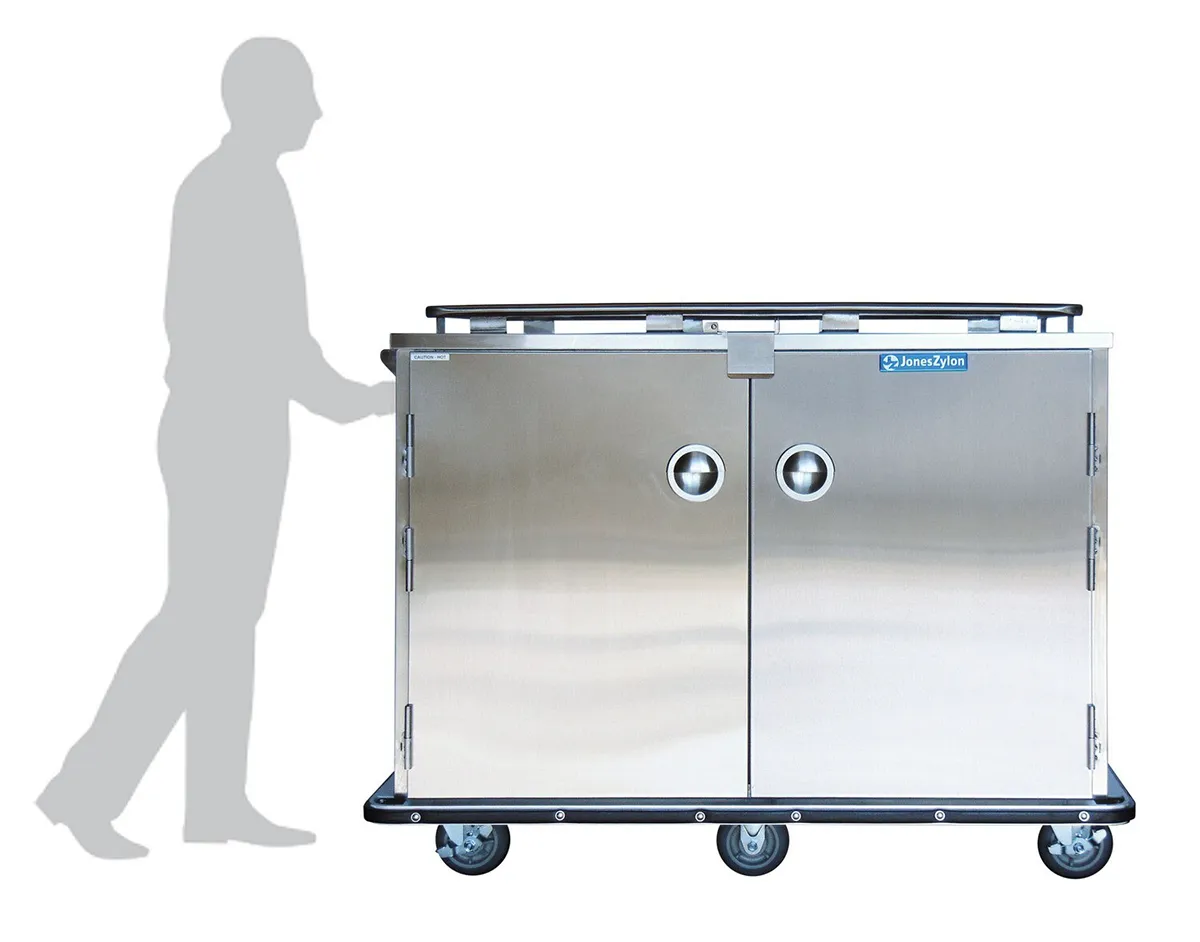
The JZHA-120 is a heated/ambient cart for use in a two-tray meal system. Its sheet lists 120 of the 9000-series segregation trays with shelves and 160 stacked without shelves. These are manufacturer specifications for that named model and arrangement. [2] Use the ServeSmart page to begin the system discussion and the segregation tray page to identify the tray for review.
Keep your planning calculation visible. Record trays per complete meal and verify complete meals per cart in the loaded trial. Cart loads equal meals divided by verified complete meals per cart, rounded up. Route trips equal cart loads divided by carts moved per trip, rounded up; plan each separate dispatch window and the return movement. Document how lids, special diets, loading order and route access affect the usable load before entering it. Add the time for loading, escort, delivery, collection and cleaning to the route worksheet. Treat observations from a demonstration as observations of that tested arrangement.
How should the facility test the delivery route?
- Describe the service. Record the housing units, meal count by diet, staffing plan, security doors, elevators and handoff locations.
- Prepare the equipment. Ask the operator to demonstrate the manufacturer-approved setup. Record the tray, lid, cart and any accessory identifiers.
- Follow the meal. Log assembly start, dispatch, arrival and final handoff. Note door openings, waiting periods and any change of staff custody.
- Measure at the agreed points. Have the food service lead specify foods, measurement technique and acceptance limits from the applicable requirements.
- Review exceptions. Record a missed meal, rejected tray or delayed unit as a separate event with the action taken.
- Complete the return. Include the dirty return trip, item count, wash queue and time when clean stock becomes available again.
How should tray washing and utensil control be documented?
Walk the return route with the sanitation lead. Identify the place for food waste, reusable articles, damaged articles and any disposable service items. Ask staff to demonstrate the approved cleaning cycle for the chosen material. Record equipment settings and the method used to check the process. Keep chemical compatibility and exposure instructions with the product documentation.
Review where trays and lids sit while drying, how staff handle clean food-contact surfaces and where the next shift obtains clean stock. Use the racking page to prepare a layout discussion. Request the exact rack and insert documentation before specifying a quantity or fit.
Ask custody staff to review the utensil options using the facility's issue and retrieval procedure. Include a practice count, an observed storage check and the escalation path for a discrepancy. Keep the reviewer and decision date in the purchase file. A material description alone leaves these operational questions unanswered.
What should go into the equipment request?
Use the RFP template to request model-specific sheets, care instructions, a configuration drawing and the records needed for your review. Include the current tray inventory and ask the supplier to identify any proposed substitution. For tray and dinnerware evaluation, Request Free Samples. For a loaded-cart discussion, Schedule a Virtual Demo.
Assign an owner to every open item in the packet. The accreditation coordinator supplies the applicable text; food service defines meal handling; custody reviews security handling; purchasing documents the transaction. Submit that packet with your quote request so the proposed equipment can be reviewed against the facility's recorded needs.
Frequently asked questions
Which ACA standard numbers cover food service?
Exact numbers are withheld because current licensed food service text could not be verified. Ask your accreditation coordinator for the applicable manual and supplements. Verify against the current edition. [1]
Can one equipment purchase establish facility accreditation?
Ask the accreditation coordinator how equipment records should support the facility review and which current requirements apply. [1]
What should we measure during a cart demonstration?
Record the actual tray and lid arrangement, usable load, route delays and food measurements specified by your food service lead. Include the last meal delivered and the dirty return.
Should we request tray samples before writing the specification?
Request samples for your proposed menu and handling review. Document the selected model, lid, wash process and custody decision in the purchase file.
Request equipment documentation for your review
Include the facility manual and edition, applicable provisions, selected model and accreditation contact.
800-848-8160 | solutions@joneszylon.com | 305 Center Street, West Lafayette, OH 43845
Sources
- ACA official FAQ, manual selection and updates. Licensed food service provisions were unavailable; verify against the current edition. https://www.aca.org/standards/faqs (accessed 2026-09-08)
- JonesZylon JZHA-120 specification, heated/ambient designation, latch and 9000-series load arrangements. /pdf/Equipment/Dual%20Temperature%20Carts/JZHA-120.pdf (accessed 2026-09-08)